大眼长尾鲨(Alopias superciliosus),隶属长尾鲨属(Alopias spp.),为大型远洋高度洄游物种,广泛分布于全球热带和温带海域,其种群资源呈持续下降趋势[1-2]。在中西太平洋(Western and Central Pacific Ocean,WCPO),大眼长尾鲨主要作为延绳钓渔业兼捕物种,是长尾鲨属中分布最广且最易受到渔业影响的鱼种[3-4]。目前,中西太平洋渔业委员会(Western and Central Pacific Fisheries Commission,WCPFC)已将大眼长尾鲨列为关键鲨鱼物种,鼓励各成员国开展相关数据收集与研究工作[5]。当前WCPFC所收集的公开数据只停留在属级别,难以精确到具体物种[4,6],从而限制了大眼长尾鲨的定量资源评估与管理[5,7]。目前,国内外对大眼长尾鲨的研究较少,多数研究基于误差相对较大的港口采样数据对其进行种群评估[8-10]。除资源评估外,研究发现,环境因子如海表面温度(sea surface temperature,SST)[11-14]、叶绿素浓度(Chlorophyll a,Chl-a)[15-17]及大尺度气候事件厄尔尼诺南方涛动(El Ni o-Southern Oscillation,ENSO)[12]等对大眼长尾鲨觅食、分布及丰度等方面具有重要影响[18]。因此,将环境因素纳入大眼长尾鲨丰度评估具有重要意义[19]。
中国延绳钓渔业观察员数据记录了具体到单鱼种的详细信息,为解决因大眼长尾鲨生产数据不足而影响资源评估与养护等问题,本研究基于该数据并结合关键环境因子构建了CPUE标准化模型。同时,利用WCPFC公布的延绳钓渔业捕捞努力量数据,估算了整个渔场大眼长尾鲨渔获量。鉴于不同船队间单位捕捞能力可能存在差异[5,20],但受限于数据共享限制约束,仅使用中国观察员数据估算的CPUE计算整个WCPO的渔获量可能存在一定偏差。因此,为检验方法的可行性与估算结果的可靠性,本文将渔获量估算结果与WCPFC科研团队基于多国观察员数据所估算的大眼长尾鲨渔获量趋势进行对比[21]。本研究中为在数据缺乏情形下利用单一来源观察员数据开展区域性渔获量估算提供了参考思路,为后续定量资源评估与有效渔业管理提供了科学支撑。
1 材料与方法
1.1 数据来源
中国金枪鱼延绳钓渔业观察员数据涵盖2010—2022年间在WCPO作业的渔船记录,包括渔船作业时间、作业经纬度、下钩数量、渔获种类与产量及渔获生物学等信息。为统一空间分辨率,将观察员原始数据按5°×5°空间网格聚合(图1),渔获量在网格内求和。为估算WCPO大眼长尾鲨渔获量,本研究采用WCPFC官网公开数据集的捕捞努力量数据(https://www.wcpfc.int/public-domain),数据包括捕捞努力量及其对应时空信息,时间分辨率为月,空间分辨率为5°×5°。
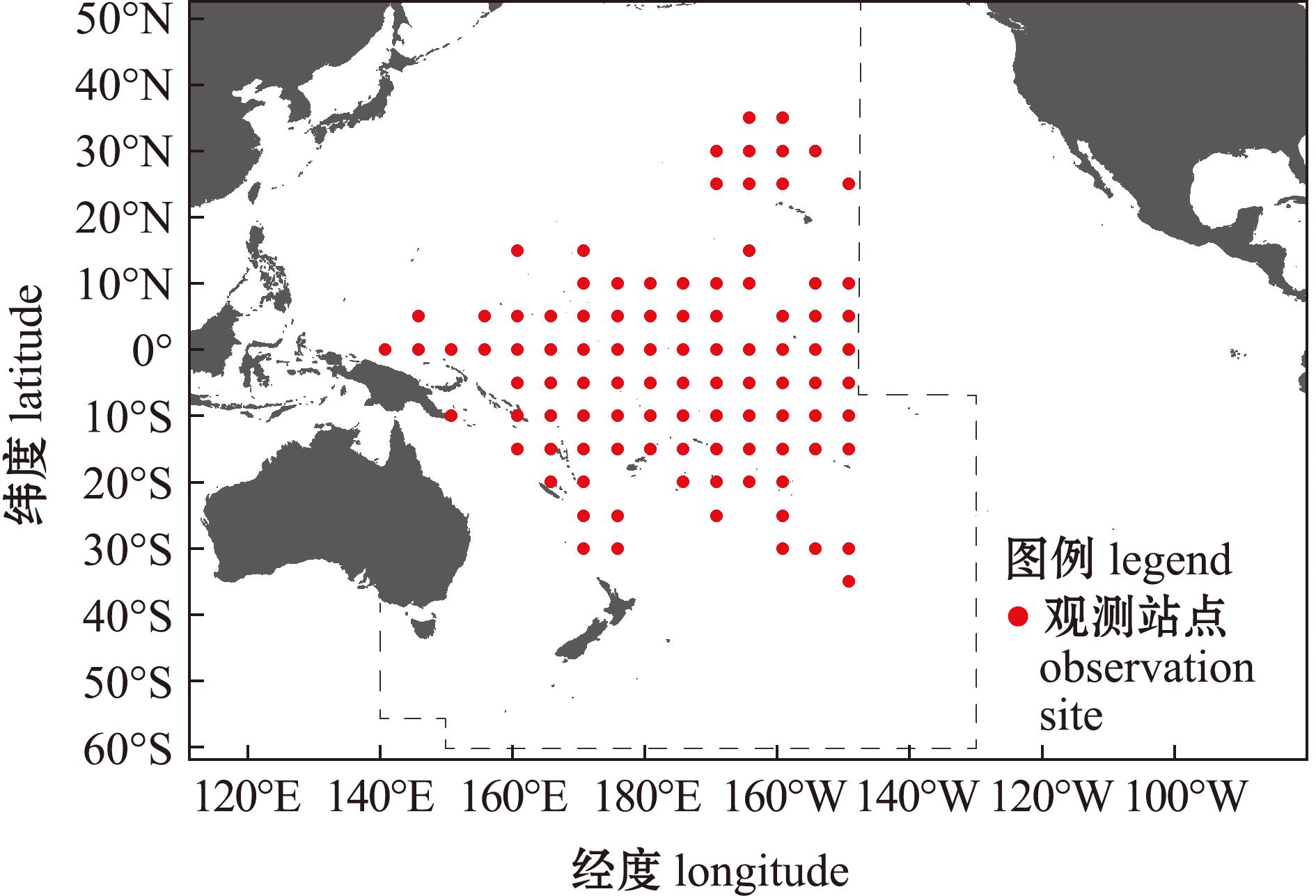
虚线为WCPFC管辖区域。
The dashed line indicates the jurisdictional area of the WCPFC.
图1 2010—2022年中国金枪鱼延绳钓渔业观察员在中西太平洋观测站点
Fig.1 Observation site of Chinese Tuna longline fishery observers in the WCPO from 2010 to 2022
环境数据包括SST、Chl-a和南方涛动指数(Southern Oscillation Index,SOI),SST和Chl-a数据来自美国国家海洋与大气管理局(National Oceanic and Atmospheric Administration,NOAA)的OceanWatch数据平台(https://oceanwatch.pifsc.noaa.gov/),时间分辨率为月,空间分辨率为5°×5°。SOI数据来自NOAA(https://psl.noaa.gov/enso/dashboard.html),时间分辨率为月[22]。
1.2 研究方法
本研究中采用Delta-lognormal广义加性模型(generalized additive model,GAM)处理数据中存在的零渔获问题[23-24]。模型选择依据赤池信息准则(akaike information criterion,AIC),AIC值越小表示模型拟合越好。通过F值与P值检验各解释变量的显著性[25]。
基于中国观察员数据与环境因子构建Delta-lognormal GAM模型,对大眼长尾鲨CPUE进行标准化,确定最优模型。将WCPFC捕捞努力量数据与相应时空环境因子作为输入变量输入模型,估算WCPO大眼长尾鲨标准化CPUE及渔获量。具体步骤如下。
1.2.1 数据处理与变量构建 CPUE定义为
CPUEi=Ci/Ei。
(1)
式中:CPUEi为第i次作业的大眼长尾鲨单位捕捞努力量渔获量(尾/千钩);Ci为第i次作业中捕获的大眼长尾鲨尾数(尾);Ei为对应作业的下钩数(千钩)。
1.2.2 Delta-lognormal GAM模型构建 首先使用二项分布GAM模型预测捕获发生概率,再使用对数正态GAM模型对非零CPUE进行拟合[26]。计算公式如下。
1)二项分布GAM模型(binomial GAM)。定义二元响应变量Yi:当CPUEi>0时Yi=1;否则Yi=0。Yi~Binomial(1,pi)。
logit(pi)=α1+s1(year_monthi)+s2(loni,lati)+s3(SSTi)+s4(Chl-ai)+s5(SOIi)。
(2)
式中:pi表示在给定时空与环境条件下单位努力量下捕获大眼长尾鲨的概率(0<pi<1);α1为截距项;s()为样条平滑函数;year_monthi表示年份和月份交互平滑项,用于捕捉CPUE随时间变化的非线性趋势;loni和lati为经纬度;SST、Chl-a及SOI分别为海表面温度、叶绿素浓度和厄尔尼诺南方涛动指数。
2)对数正态GAM模型(Lognormal GAM)。
log(CPUEi)=α2+s1(year_monthi)+s2(loni,lati)+s3(SSTi)+s4(Chl-ai)+s5(SOIi)+εi。
(3)
式中:α2为截距项;εi为正态分布的随机误差项;其他变量定义同前。
3)模型结合。综合两个子模型,Delta-lognormal GAM的总预测值为
 。
。
(4)
式中: 为二项分布模型预测渔获发生概率;
 为对数正态模型的预测值。
4)模型拟合与变量选择。使用R语言中的“mgcv”程序包[27]拟合GAM模型,计算方差膨胀因子(variance inflation factor,VIF)以诊断解释变量之间是否存在多重共线性,最后基于最小AIC值选择最优模型。
1.2.3 WCPO大眼长尾鲨渔获量估算与不确定性分析 确定最佳Delta-lognormal GAM模型后,将WCPO捕捞努力量所对应的SST、Chl-a、SOI数据及时空数据输入GAM模型,预测每个5°×5°单元格的大眼长尾鲨CPUE,后结合捕捞努力量进一步预测渔获量变化趋势。渔获量计算公式为
 。
。
(5)
式中: 为第j个网格单元的预测渔获量(尾数);Ej为该时空单元捕捞努力量(千钩)。
使用重采样技术对参数进行自助抽样(parametric bootstrap)以构建95%置信区间[28]。基于Delta-lognormal GAM逻辑回归模型与对数正态模型提取系数及协方差矩阵,按渐近正态近似分别各抽取1 000组回归系数;在既定时空与环境协变量下预测各努力量单元的期望CPUE,与努力量相乘得渔获量并按年汇总。每年以自助均值为点估计、2.5%与97.5%分位为95%区间。
2 结果与分析
2.1 因子筛选与模型选择
为避免多重共线性对模型稳定性的影响,VIF检验分析结果显示(表1),7个影响因子的VIF值均小于2,表明各变量间不存在多重共线性问题。
表1 影响因子的多重共线性检验
Tab.1 Multicollinearity test of influencing factors

影响因子factor年份year月份month经度longitude纬度latitude南方涛动指数SOI海表面温度SST叶绿素浓度Chl-a方差膨胀因子 VIF1.0741.0981.1981.0691.1111.1631.242
图2为对数正态模型的残差直方图和Q-Q正态图。模型对极端值数据拟合较差,除极端值外,数据整体部分拟合结果相对较好,残差分布接近正态分布。
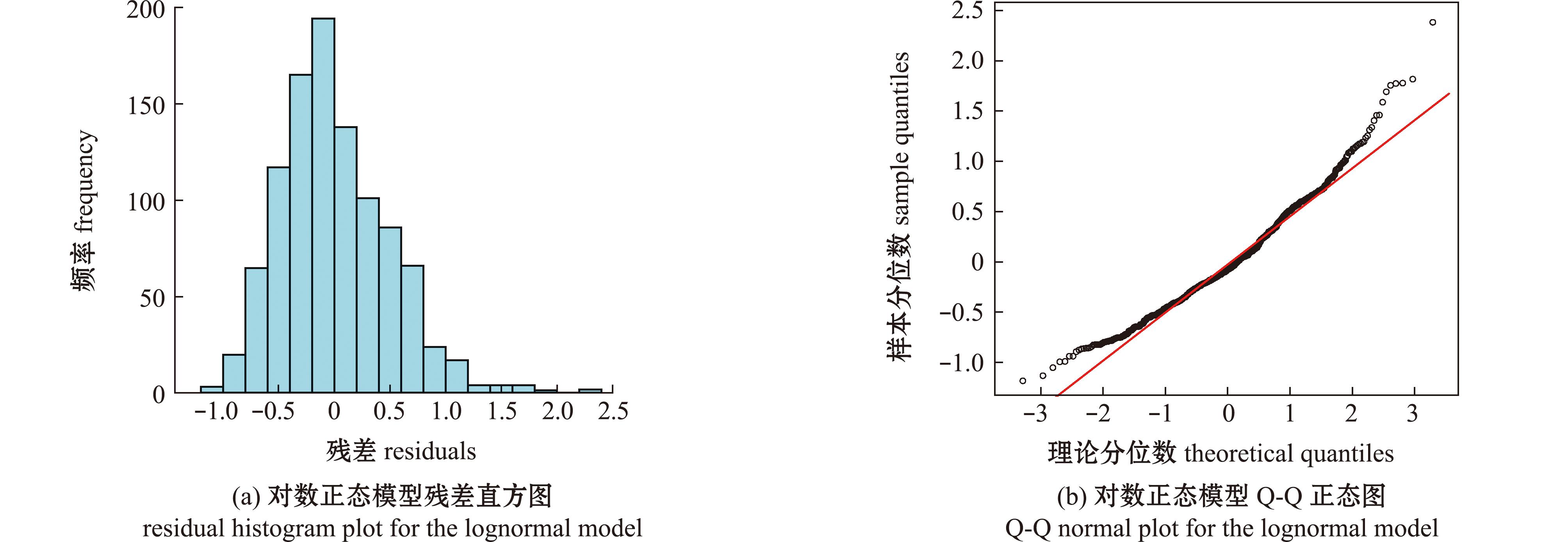
图2 对数正态模型残差直方图和Q-Q正态图
Fig.2 Residual histogram and Q-Q normal plot for the lognormal model
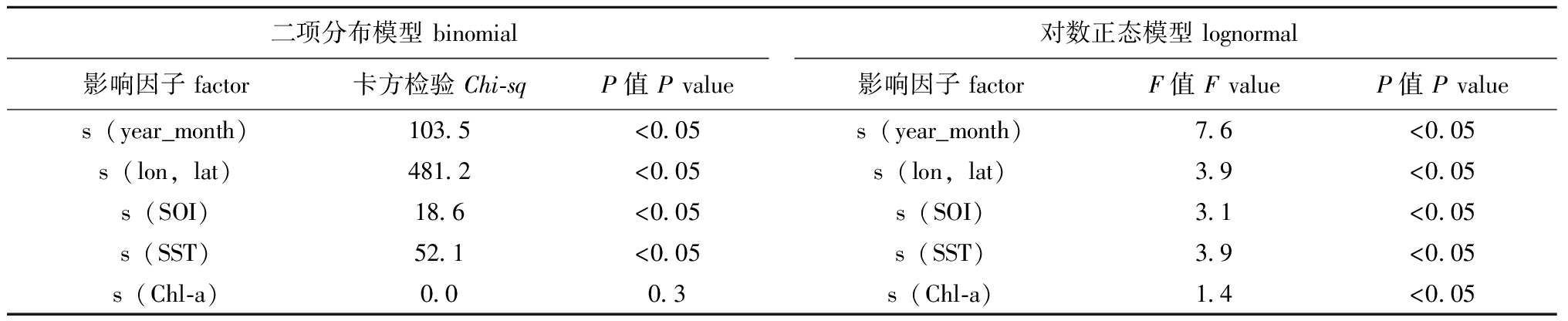
Delta-lognormal GAM模型各因子统计结果(表2)显示,除二项分布模型中Chl-a变量P值为0.3,影响不显著(P>0.05),其余解释变量在二项分布模型和对数正态模型均具有显著性影响(P<0.05),表明这些变量在解释大眼长尾鲨CPUE变化中具有重要作用。
表2 Delta-lognormal GAM模型各因子统计
Tab.2 Statistics of each factor of the Delta-lognormal GAM model
二项分布模型 binomial对数正态模型 lognormal影响因子 factor卡方检验 Chi-sqP值 P value影响因子 factorF值 F valueP值 P values(year_month)103.5<0.05s(year_month)7.6<0.05s(lon,lat)481.2<0.05s(lon,lat)3.9<0.05s(SOI)18.6<0.05s(SOI)3.1<0.05s(SST)52.1<0.05s(SST)3.9<0.05s(Chl-a)0.00.3s(Chl-a)1.4<0.05
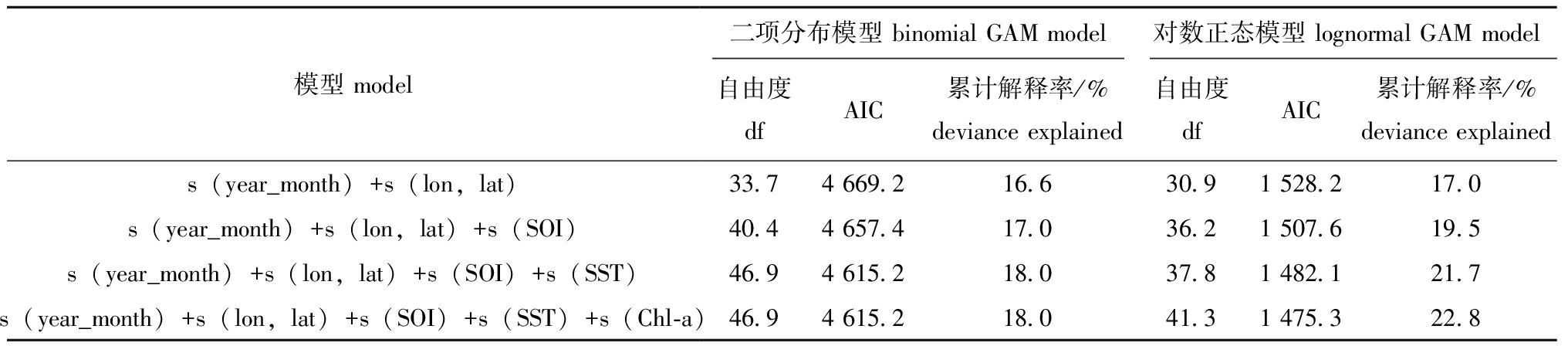
Delta-lognormal GAM模型拟合结果的偏差分析(表3)用于比较不同模型的拟合效果。通过逐步引入各解释变量,基于最小AIC值和P值选择的最优二项分布模型包含除Chl-a外的所有因子,累计偏差解释率为18.0%,最低AIC值为4 615.2;最优对数正态模型包含所有因子,累计偏差解释率为22.8%,最低AIC值为1 475.3。
表3 Delta-lognormal GAM模型拟合结果的偏差分析
Tab.3 Deviation analysis of the fitting results of the Delta-lognormal GAM model
模型 model二项分布模型 binomial GAM model对数正态模型 lognormal GAM model自由度dfAIC累计解释率/%deviance explained自由度dfAIC累计解释率/%deviance explaineds(year_month)+s(lon,lat)33.74 669.216.630.91 528.217.0s(year_month)+s(lon,lat)+s(SOI)40.44 657.417.036.21 507.619.5s(year_month)+s(lon,lat)+s(SOI)+s(SST)46.94 615.218.037.81 482.121.7s(year_month)+s(lon,lat)+s(SOI)+s(SST)+s(Chl-a)46.94 615.218.041.31 475.322.8
2.2 大眼长尾鲨渔获量估算及标准化CPUE
图3所示为2010—2022年基于观察员数据(CPUEOBS)与基于WCPFC发布的捕捞努力量数据(CPUEWCPFC)采用Delta-lognormal GAM模型得到的大眼长尾鲨标准化CPUE年际变化趋势。结果显示,CPUEOBS与CPUEWCPFC年际变化趋势相似,2010—2016年标准化CPUE波动下降,2017年达到峰值后持续下降。CPUEWCPFC波动幅度小于CPUEOBS,以上数据均显示大眼长尾鲨标准化CPUE整体呈波动下降趋势。
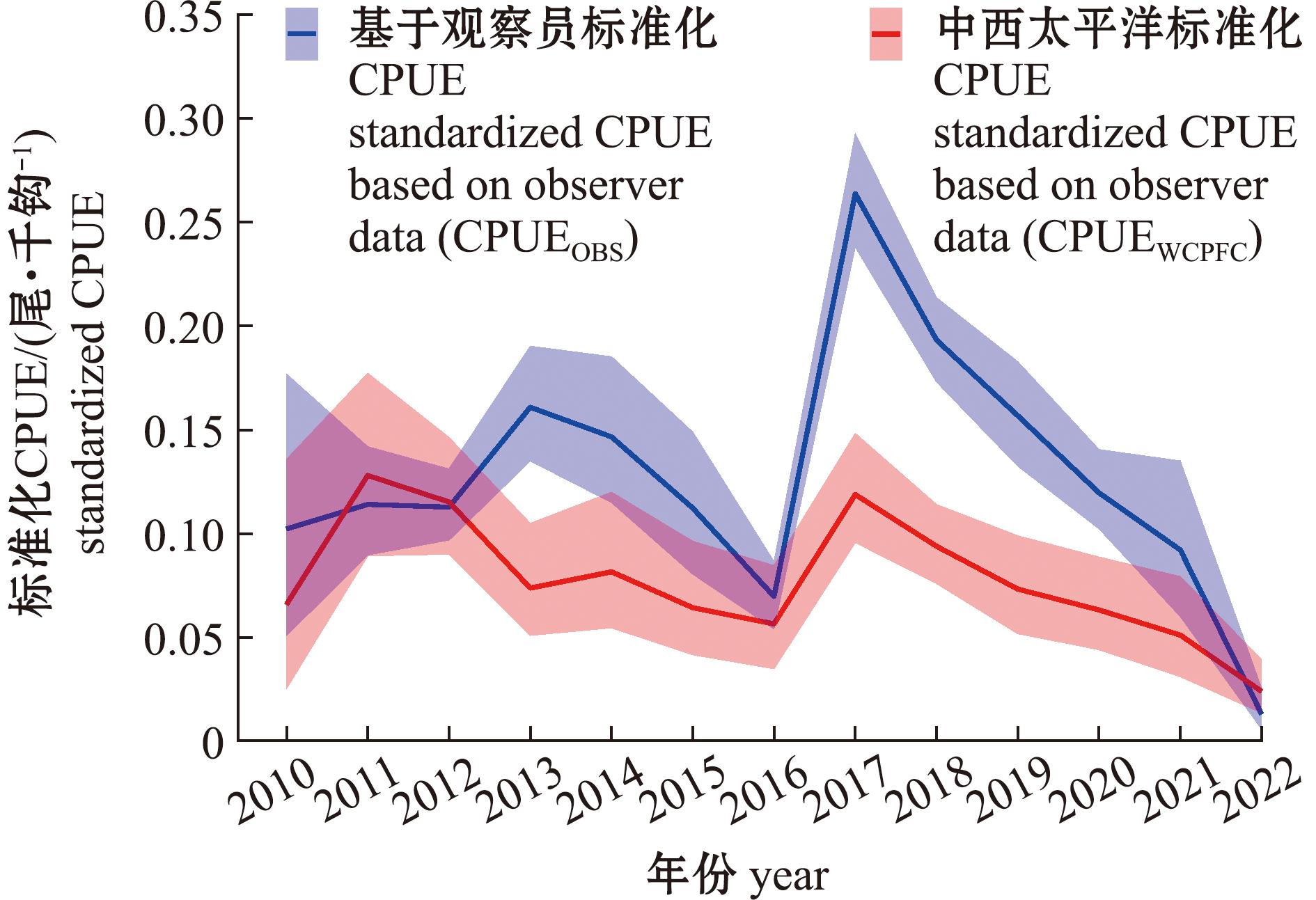
CPUEOBS—基于观察员数据;CPUEWCPFC—基于WCPFC数据。
CPUEOBS—based on observer data;CPUEWCPFC—based on WCPFC data.
图3 2010—2022年大眼长尾鲨标准化的CPUE
Fig.3 Standardized CPUE of bigeye thresher shark from 2010 to 2022
图4为WCPO大眼长尾鲨估算渔获量年际变化趋势。CatchOBS代表基于中国延绳钓渔业观察员数据的估算结果,CatchWCPFC代表WCPFC科研团队估算渔获量[21]。结果显示,利用中国观察员数据的估算渔获量在2012年达到峰值(约6.7万尾),此后呈波动下降趋势。2017年小幅回升(约4.9万尾),此后又持续下降至2022年最低水平。将本研究估算的CatchOBS与CatchWCPFC对比,在相同时间序列2010—2019年,二者总体变化趋势相似,均反映渔获量先升后降的趋势,且在高峰期存在较大不确定性,但基于中国观察员估算的值整体相对较低。
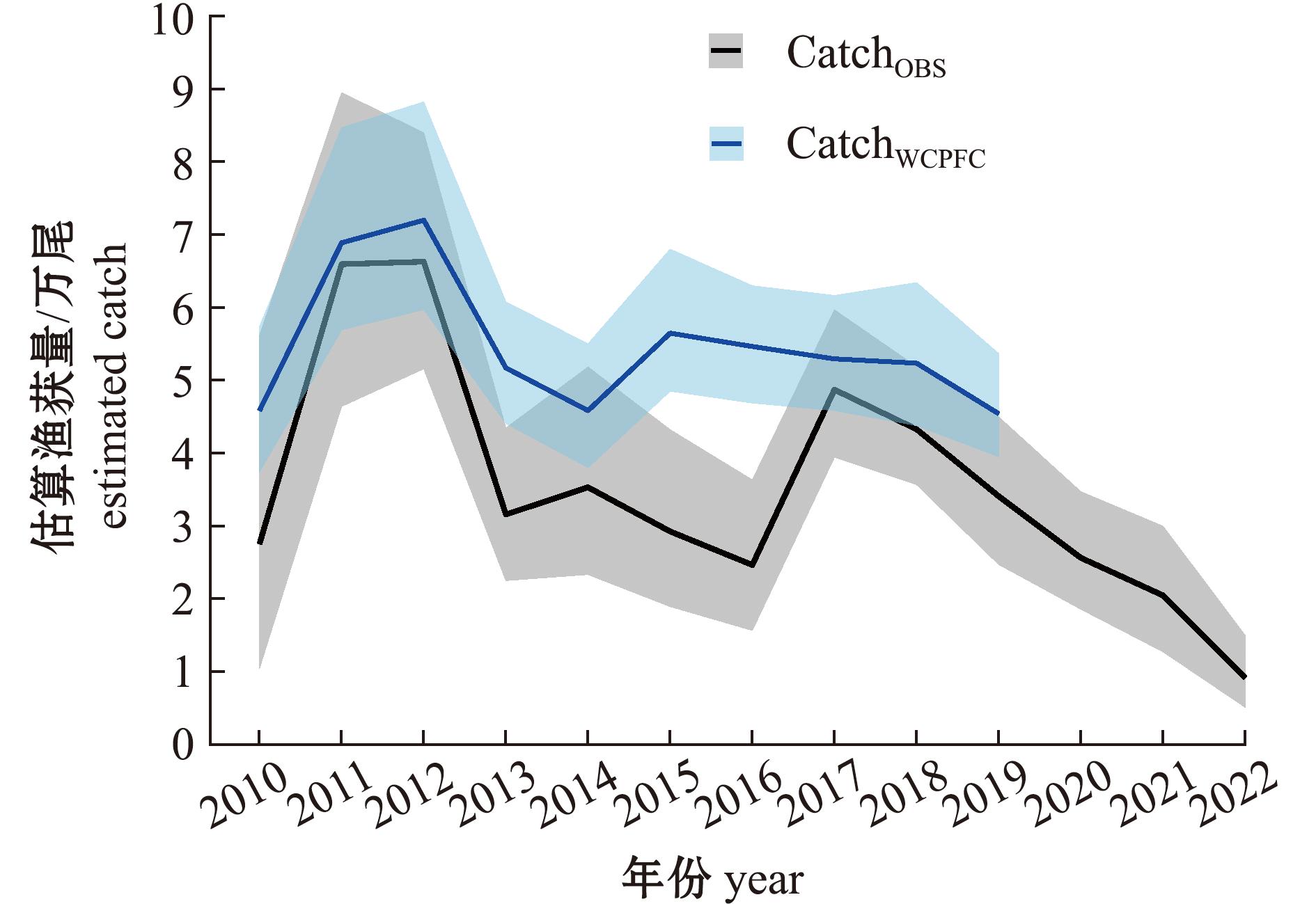
图4 WCPO大眼长尾鲨估算渔获量的变化
Fig.4 Estimated catch of bigeye thresher sharks in the WCPO
3 讨论
3.1 环境变量影响分析
本研究中基于Delta-lognormal GAM模型评估了时间、空间及关键环境因子对大眼长尾鲨CPUE的影响。其中,时间效应、空间效应及SST在二项分布和对数正态GAM模型中均对CPUE具有显著性影响(P<0.05),表明大眼长尾鲨CPUE与时空变化高度相关,可能反映其对季节性及海洋环境变化的洄游响应。已有研究指出,洄游性鲨鱼分布受时空环境梯度影响显著,且其分布热点区域往往与延绳钓渔船作业区高度重叠[16]。李鹏等[29]研究发现,SOI变化与WCPO金枪鱼渔场重心位置变化密切相关,本研究中SOI在模型两个部分中均具有显著性影响(P<0.05),显示厄尔尼诺事件可能通过改变渔场位置和生态环境,间接影响大眼长尾鲨的分布与渔获率。Chl-a仅在对数正态模型中显著,表明其更可能影响渔获强度,与大眼长尾鲨偏好初级生产力较高海域以提高觅食机会的行为特征一致[14,30]。本研究中在物种层面将SST、Chl-a及SOI等关键环境变量纳入模型,提高了CPUE标准化的解释力,揭示了种群分布的时空动态及环境驱动机制[31]。
3.2 模型适用性、标准化CPUE及渔获量估算
近年来,针对兼捕物种的CPUE标准化普遍采用两阶段Delta模型和零膨胀模型[32-33]。Delta-lognormal模型[26]可分别建模渔获发生概率与正渔获量,已广泛应用于大青鲨(Prionace glauca)[34-35]、长尾鲨[28]、短鳍鲭鲨(Isurus oxyrinchus)[36]、牛鲨(Carcharhinus leucas)[37]等鲨鱼物种的CPUE标准化中,并表现出良好的适应性。本研究中基于中国观察员数据构建Delta-lognormal GAM模型,并结合WCPFC努力量与环境因子,估算WCPO大眼长尾鲨的标准化CPUE及渔获量。结果显示,基于中国观察员数据的标准化CPUE(CPUEOBS)与估算的WCPO尺度标准化CPUE(CPUEWCPFC)变化趋势基本一致,表明中国观察员数据能较好反映大眼长尾鲨CPUE区域性变化。其中,CPUEWCPFC整体变化相对平稳,波动幅度较小,更能代表区域总体趋势。需要指出的是,2017年CPUEOBS显著高于CPUEWCPFC,可能源于该年度中国船队主要作业海域的大眼长尾鲨资源密度较高,导致CPUE估算偏高。为验证渔获量估算结果,本研究中将估算渔获量与WCPFC科研团队[21]基于多个国家观察员数据的估算结果进行对比。研究表明,在相同时间序列(2010—2019年)年际变化趋势相似,均在2012年达到峰值后下降,且大多数年份估算值在数量级上接近。但本研究中的整体估算值低于WCPFC科研团队估算结果,尤其在2013—2016年差异较大,可能与此期间中国观察员覆盖率不足、样本量有限导致CPUE估算不确定性增加有关。此外,受COVID-19影响,包括中国在内的WCPFC延绳钓渔业观察员覆盖率普遍下降[38],航次数减少进一步削弱了数据代表性,导致2020—2022年CPUE和渔获量估算精度下降[21]。尽管本研究与WCPFC科研团队在数据来源及建模方法上存在差异,但结果表明,基于中国观察员数据并结合环境因子的Delta-lognormal GAM模型,能较为合理地反映WCPO大眼长尾鲨种群动态,验证了在数据有限条件下利用中国观察员数据估算区域性大眼长尾鲨渔获量的可行性,为类似情境下的资源评估提供了参考。Tsai等[8,39]于2019年及2020年采用数据有限方法对西北太平洋大眼长尾鲨进行资源评估,结果均显示,当前大眼长尾鲨捕捞死亡率已超过生物参考点,种群处于过度捕捞状态。结合本研究标准化CPUE及渔获量变化趋势,进一步表明WCPO大眼长尾鲨资源呈持续下降趋势,并面临过度捕捞风险。
4 结论
1)在数据有限背景下,本研究中基于中国观察员数据构建了Delta-lognormal GAM模型,并结合WCPFC捕捞努力量与环境因子,估算了WCPO大眼长尾鲨的标准化CPUE及渔获量,研究结果能够较为合理地反映WCPO大眼长尾鲨的资源利用状况,为数据缺乏情况下开展单种评估提供了可行途径。
2)大眼长尾鲨CPUE的时空变动规律及其对海表面温度等关键环境因子的显著响应,表明该物种在渔场分布与海洋环境变化之间存在紧密联系。
3)目前,研究者对WCPO大眼长尾鲨的生物学特征、种群结构及环境响应了解仍有限,需持续开展生物学数据收集、长期监测及气候变化影响研究,为物种保护、渔业管理提供科学依据。
[1] BOOTH H,SQUIRES D,MILNER-GULLAND E J.The neglected complexities of shark fisheries,and priorities for holistic risk-based management[J].Ocean &Coastal Management,2019,182:104994.
[2] DULVY N K,PACOUREAU N,RIGBY C L,et al.Overfishing drives over one-third of all sharks and rays toward a global extinction crisis[J].Current Biology,2021,31(21):4773-4787.e8.
[3] MATSUNAGA H,YOKAWA K.Distribution and ecology of bigeye thresher Alopias superciliosus in the Pacific Ocean[J].Fisheries Science,2013,79(5):737-748.
[4] RICE J,TREMBLAY-BOYER L,SCOTT R,et al.Analysis of stock status and related indicators for key shark species of the Western Central Pacific Fisheries Commission [R].Manila,Philippines: Western and Central Pacific Fisheries Commission,2015.
[5] FU D,ROUX M J,SHELLEY C,et al.Pacific-wide sustainability risk assessment of bigeye thresher shark (Alopias superciliosus) [R].Rarotonga,Cook Islands: Western and Central Pacific Fisheries Commission,2016.
[6] CLARKE S.A status snapshot of key shark species in the western and central Pacific and potential management options [R].Majuro,Marshall Islands: Western and Central Pacific Fisheries Commission,2014.
[7] 朱江峰,戴小杰,陈彦.运用生产力-易捕率指数对10种热带太平洋鲨鱼种群的研究[J].南方水产科学,2013,9(6):8-13. ZHU J F,DAI X J,CHEN Y.Productivity-susceptibility analysis of ten shark populations in tropical Pacific Ocean[J].South China Fisheries Science,2013,9(6):8-13.(in Chinese)
[8] TSAI W P,LIU K M,CHANG Y J.Evaluation of biological reference points for conservation and management of the bigeye thresher shark,Alopias superciliosus,in the northwest Pacific[J].Sustainability,2020,12(20):8646.
[9] TSAI W P,HUANG C H.Data-limited approach to the management and conservation of the pelagic thresher shark in the Northwest Pacific[J].Conservation Science and Practice,2022,4(6):e12682.
[10] RAHARJO B,HARTATI R,REDJEKI S.Population status of thresher shark listed in Appendix Ⅱ CITES of Southern Java Seas,Indonesia[J].Egyptian Journal of Aquatic Research,2024,50(2):260-266.
[11] BLOCK B A,JONSEN I D,JORGENSEN S J,et al.Tracking apex marine predator movements in a dynamic ocean[J].Nature,2011,475(7354):86-90.
[12] OSGOOD G J,WHITE E R,BAUM J K.Effects of climate-change-driven gradual and acute temperature changes on shark and ray species[J].Journal of Animal Ecology,2021,90(11):2547-2559.
[13] KAI M,THORSON J T,PINER K R,et al.Predicting the spatio-temporal distributions of pelagic sharks in the western and central North Pacific[J].Fisheries Oceanography,2017,26(5):569-582.
[14] QUEIROZ N,HUMPHRIES N E,MUCIENTES G,et al.Ocean-wide tracking of pelagic sharks reveals extent of overlap with longline fishing hotspots[J].Proceedings of the National Academy of Sciences of the United States of America,2016,113(6):1582-1587.
[15] QUEIROZ N,VILA-POUCA C,COUTO A,et al.Convergent foraging tactics of marine predators with different feeding strategies across heterogeneous ocean environments[J].Frontiers in Marine Science,2017,4:239.
[16] QUEIROZ N,HUMPHRIES N E,COUTO A,et al.Global spatial risk assessment of sharks under the footprint of fisheries[J].Nature,2019,572(7770):461-466.
[17] ROHNER C A,RICHARDSON A J,JAINE F R A,et al.Satellite tagging highlights the importance of productive Mozambican coastal waters to the ecology and conservation of whale sharks[J].PeerJ,2018,6:e4161.
[18] 张嘉旭,李泽政,沈永富,等.基于稳定同位素混合模型的热带东太平洋4种鲨鱼摄食差异[J].大连海洋大学学报,2023,38(4):663-670. ZHANG J X,LI Z Z,SHEN Y F,et al.Feeding differences of feeding ecology of four shark species in the tropical eastern Pacific Ocean using stable isotope Mixing model[J].Journal of Dalian Ocean University,2023,38(4):663-670.(in Chinese)
[19] CHEUNG W W L,WATSON R,PAULY D.Signature of ocean warming in global fisheries catch[J].Nature,2013,497:365-368.
[20] YOUNG C N,CARLSON J K,HUTCHINSON M R,et al.Status review report: common thresher shark (Alopias vulpinus) and bigeye thresher shark (Alopias superciliosus) [R].Silver Spring,MD,USA: National Marine Fisheries Service,Office of Protected Resources,2016.
[21] PEATMAN T,ALLAIN V,BELL L,et al.Estimating trends and magnitudes of bycatch in the tuna fisheries of the Western and Central Pacific Ocean[J].Fish and Fisheries,2023,24(5):812-828.
[22] ROPELEWSKI C F,JONES P D.An extension of the Tahiti-Darwin southern oscillation index[J].Monthly Weather Review,1987,115(9):2161-2165.
[23] CARVALHO F C,MURIE D J,HAZIN F H V,et al.Spatial predictions of blue shark (Prionace glauca) catch rate and catch probability of juveniles in the Southwest Atlantic Open Access[J].ICES Journal of Marine Science,2011,68(5):890-900.
[24] ICHSAN M,ULA S,BOOTH H,et al.Catch,bycatch,and mitigation options for endangered sharks in data poor fisheries:a case study on pelagic thresher sharks (Alopias pelagicus) in the eastern Indian Ocean[J].Pacific Conservation Biology,2024,30(6):PC23050.
[25] VENABLES W N,DICHMONT C M.GLMs,GAMs and GLMMs:an overview of theory for applications in fisheries research[J].Fisheries Research,2004,70(2/3):319-337.
[26] LO N C,JACOBSON L D,SQUIRE J L.Indices of relative abundance from fish spotter data based on delta-lognornial models[J].Canadian Journal of Fisheries and Aquatic Sciences,1992,49(12):2515-2526.
[27] WOOD S N.Fast stable restricted maximum likelihood and marginal likelihood estimation of semiparametric generalized linear models[J].Journal of the Royal Statistical Society:Series B (Statistical Methodology),2011,73(1):3-36.
[28] LAWSON T.Estimation of catch rates and catches of key shark species in tuna fisheries of the Western and Central Pacific Ocean using observer data [R].Pohnpei,Federated States of Micronesia: Western and Central Pacific Fisheries Commission,2011.
[29] 李鹏,许柳雄,周成,等.中西太平洋金枪鱼围网自由鱼群渔场重心变动及其与南方涛动指数的关系[J].南方水产科学,2020,16(2):70-76. LI P,XU L X,ZHOU C,et al.Variation of fishing ground gravity of tuna free-swimming school caught by purse seiner in Western and Central Pacific Ocean and its relationship with Southern Oscillation Index[J].South China Fisheries Science,2020,16(2):70-76.(in Chinese)
[30] SCALES K L,HAZEN E L,JACOX M G,et al.Fisheries bycatch risk to marine megafauna is intensified in Lagrangian coherent structures[J].Proceedings of the National Academy of Sciences of the United States of America,2018,115(28):7362-7367.
[31] O’LEARY C A,THORSON J T,IANELLI J N,et al.Adapting to climate-driven distribution shifts using model-based indices and age composition from multiple surveys in the walleye pollock (Gadus chalcogrammus) stock assessment[J].Fisheries Oceanography,2020,29(6):541-557.
[32] SHONO H.Application of the Tweedie distribution to zero-catch data in CPUE analysis[J].Fisheries Research,2008,93(1/2):154-162.
[33] MUKO S,YODA M,KUROTA H,et al.Spatial estimation and yearly trends in abundance-index of Japanese jack mackerel (Trachurus japonicus) in the East China Sea and Sea of Japan[J].Fisheries Research,2023,266:106781.
[34] LIU K M,SU K Y.Updated standardized CPUE,size and spatial distribution of blue shark (Prionace glauca) caught by the Chinese Taipei longline fishery in the Atlantic Ocean [J].Collect Vol Sci Pap ICCAT,2023,80(4): 306-336.
[35] TSAI W P,SUN C L,LIU K M,et al.CPUE standardization and catch estimate of blue shark by Taiwanese large-scale tuna longline fishery in the north Pacific Ocean[J].Journal of Marine Science and Technology,2015,23:567-574.
[36] O’FARRELL H B,BABCOCK E A.Shortfin mako hot sets-Defining high bycatch conditions as a basis for bycatch mitigation[J].Fisheries Research,2021,244:106123.
[37] HAIG J A,LAMBERT G I,SUMPTON W D,et al.Habitat features influence catch rates of near-shore bull shark (Carcharhinus leucas) in the Queensland Shark Control Program,Australia 1996-2012[J].Estuarine,Coastal and Shelf Science,2018,200:289-300.
[38] PANIZZA A,WILLIAMS P,FALASI C,et al.Status of observer data management [R].Pohnpei,Federated States of Micronesia: Western and Central Pacific Fisheries Commission,2022.
[39] TSAI W P,CHANG Y J,LIU K M.Development and testing of a Bayesian population model for the bigeye thresher shark,Alopias superciliosus,in an area subset of the western North Pacific[J].Fisheries Management and Ecology,2019,26(3):269-294.